Chembook · iPhone

Chemistry in your hand. In three dimensions.

The reference you reach for mid-problem — all 118 elements, the NMR and IR tables, the constants and the glossary — next to things no book can do: ninety mechanisms you step through in 3D, computed orbitals you rotate, and a dynamics lab that integrates the equations of motion while you watch. Every byte of it on the device, with no account and no network.

iPhone · iOS 17 and later

What is inside

Five things it does that a textbook cannot.

Chembook is not a PDF with a search box. Each of these is interactive because the underlying data is real — precomputed quantum chemistry, shipped in the download and read from your device.

01 / REACTIONS

Step through the mechanism, not a diagram.

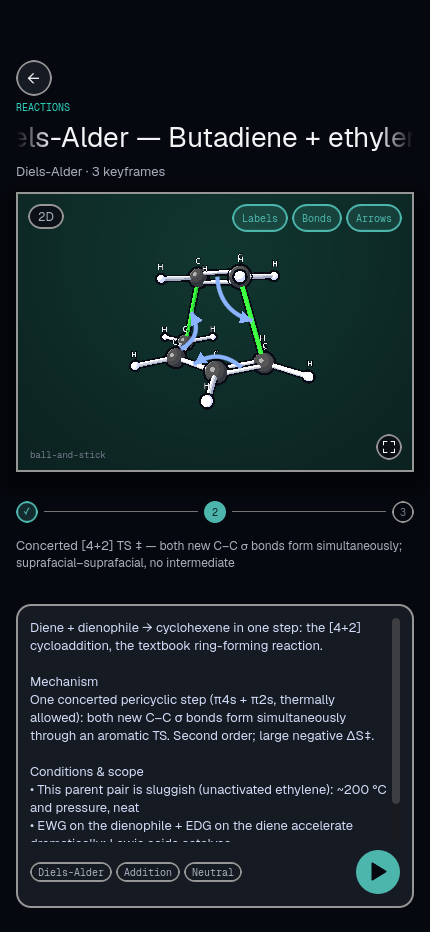
Ninety named organic mechanisms, frame by frame. Every structure is a real geometry — most of them quantum-optimized — with curved electron-pushing arrows drawn on the actual atoms rather than sketched over a picture. Toggle any reaction between the 3D model and a clean 2D skeletal depiction.

90 mechanismsQM geometriesElectron arrows2D ⇄ 3D
The Chembook reaction viewer showing a Diels-Alder transition state with electron-pushing arrows

02 / ORBITALS

Orbitals you can turn in your hand.

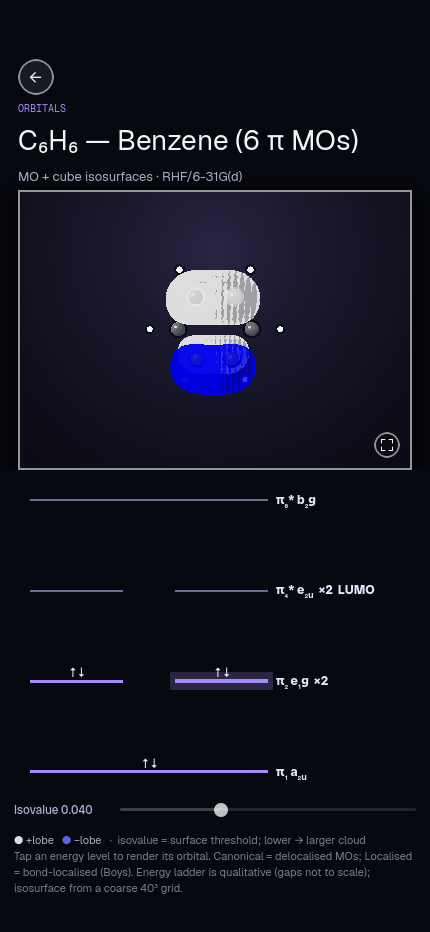
Real computed isosurfaces rendered from volumetric data, not illustrations — s, p, d and f atomic orbitals through to molecular orbitals, with an energy ladder you tap to render each level and an isovalue control to thin or thicken the surface.

Computed isosurfacesMO ladderIsovalue control
Benzene molecular orbitals with the pi energy ladder below the 3D isosurface

03 / VIBRATIONS

Watch the molecule move on each band.

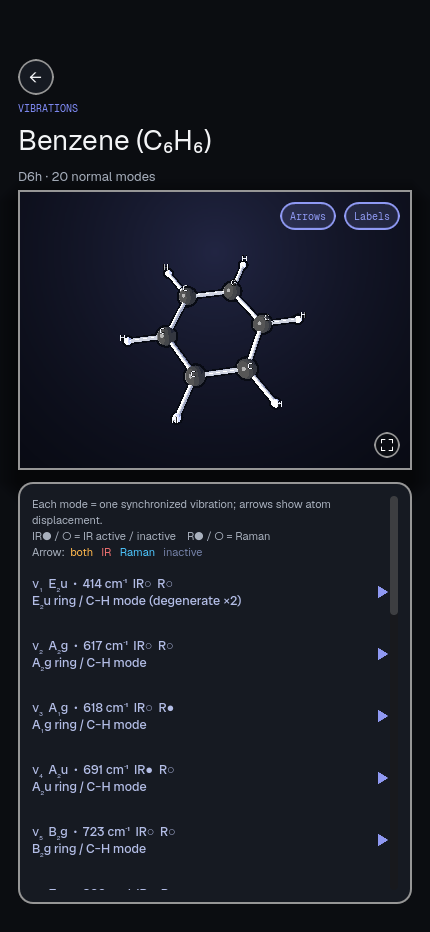
Computed normal modes animated on the structure itself — pick a band and see exactly which stretch or bend it belongs to, with its symmetry label and whether it is IR or Raman active. The step between a spectrum and the motion behind it, which a printed table can only assert.

Animated normal modesSymmetry labelsIR / Raman activity
The Chembook vibration module animating a computed normal mode with its symmetry label

04 / DYNAMICS

A simulation, not an animation.

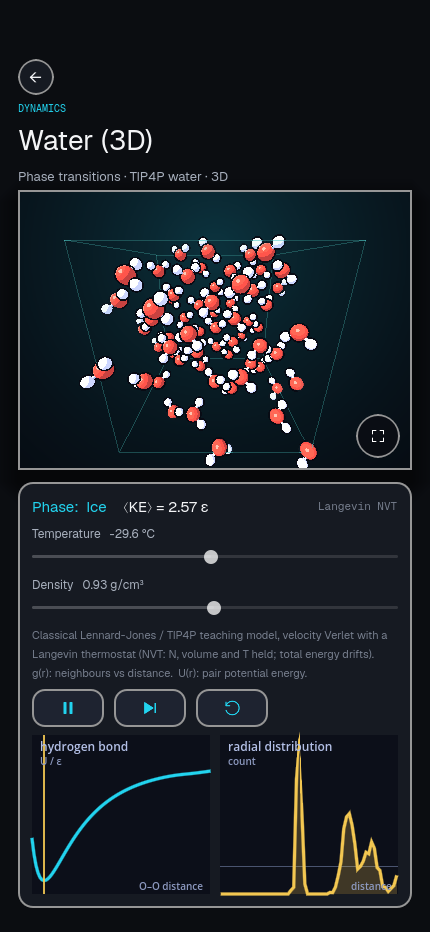
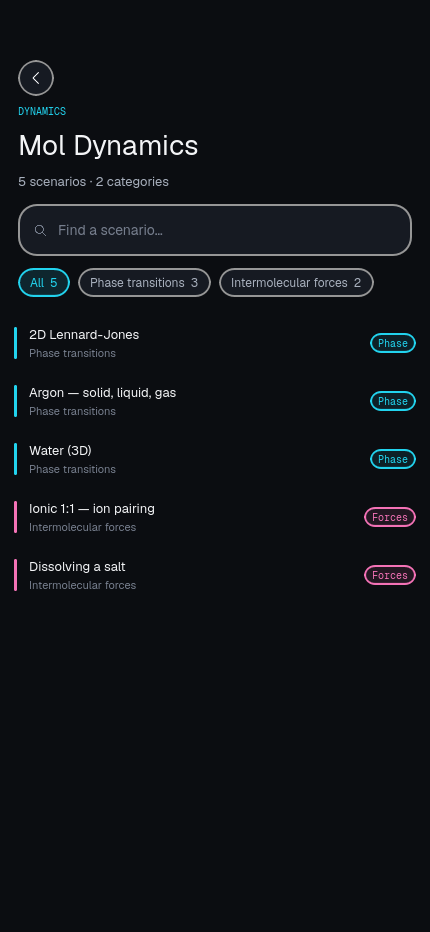
Argon condensing, water freezing into an ice lattice and melting again, salt dissolving in a polar solvent. Velocity Verlet with a Langevin thermostat, temperature and density under your control, and the radial distribution function redrawing as it runs.

Lennard-JonesTIP4P waterLive g(r)Phase detection
The molecular dynamics lab running TIP4P water in the ice phase with live g(r) plots

05 / QUIZ

Recall practice that is actually chemistry.

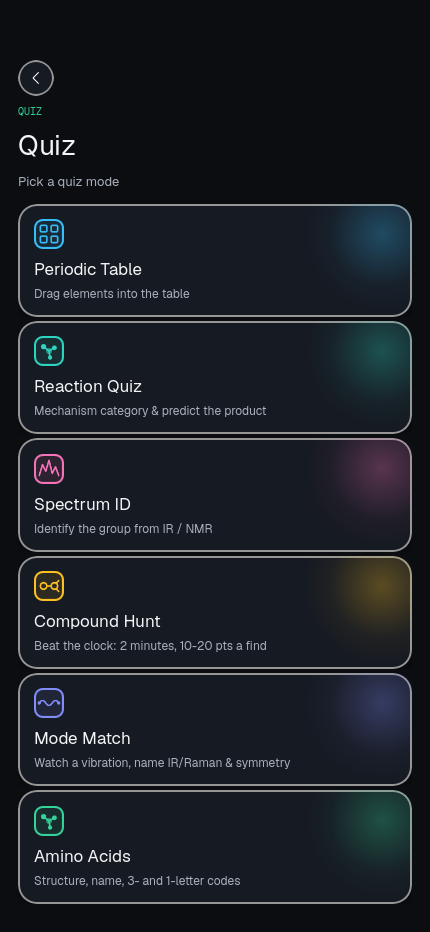
Six modes: drag elements into the periodic table, draw compounds on a Lewis word-search grid against the clock, classify reaction mechanisms and predict the product, identify a group from its IR or NMR, name a vibration you are watching, and recall amino acids by structure and code. Scored, timed, and drawn from the same data as the reference side of the app.

6 modesTimed & scoredMastery tracking
The Chembook quiz hub showing the five available quiz modes

And the rest of it

Everything else you look up.

Periodic table

Periodic table

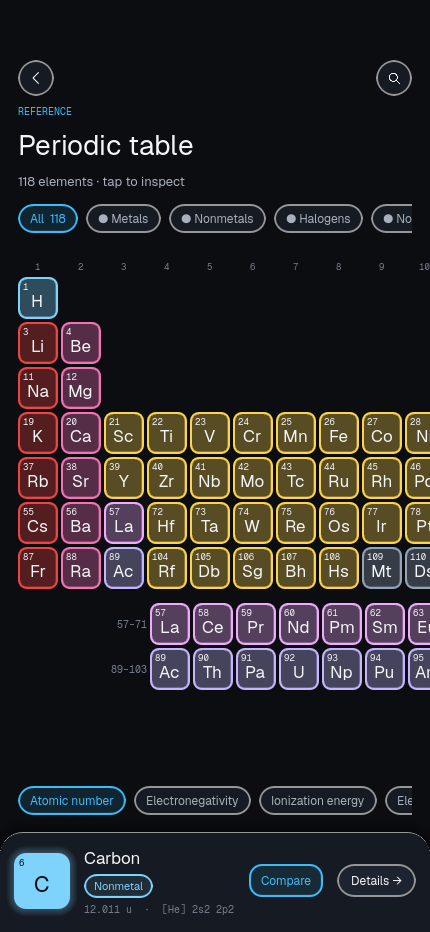
All 118 elements with trends, a comparison view and full property detail for each.

Structures & conformers

Structures & conformers

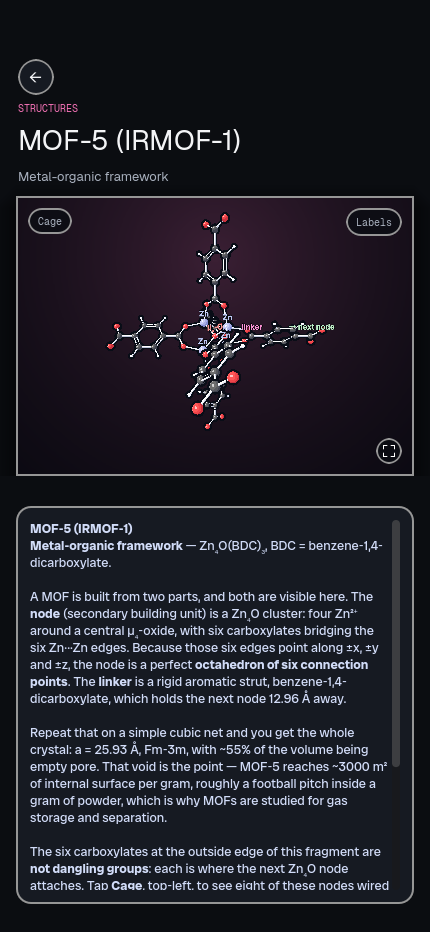
Chair flips, anomers, amino acids, unit cells and framework solids, with a draggable Ramachandran plot.

Spectroscopy tables

Spectroscopy tables

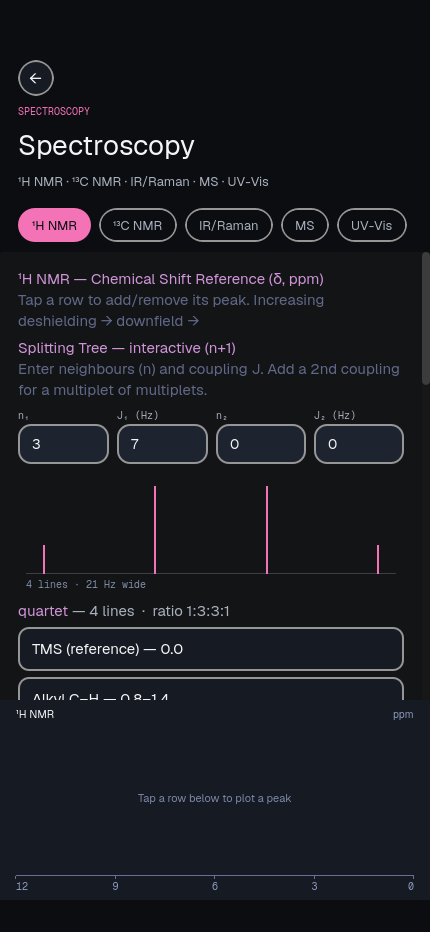
¹H and ¹³C NMR shifts, IR and Raman bands, MS and UV-Vis — tap a row to plot its peak.

Encyclopedia

Encyclopedia

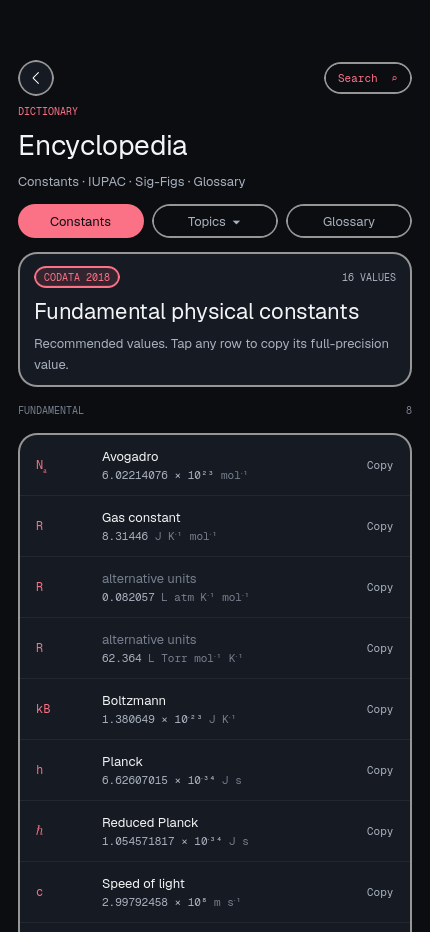
Constants, IUPAC nomenclature, significant figures, and a searchable glossary across ten topics.

Chemistry calculators

Chemistry calculators

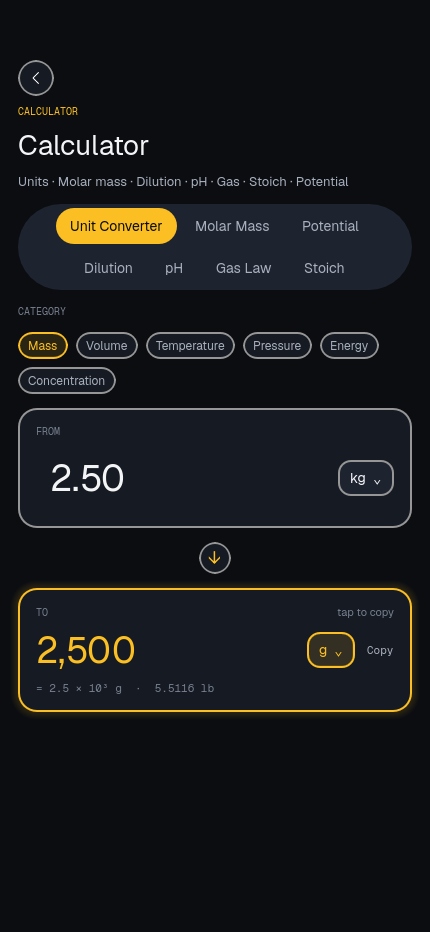
Stoichiometry, dilution, pH and gas laws, with significant figures handled properly.

Notes

Notes

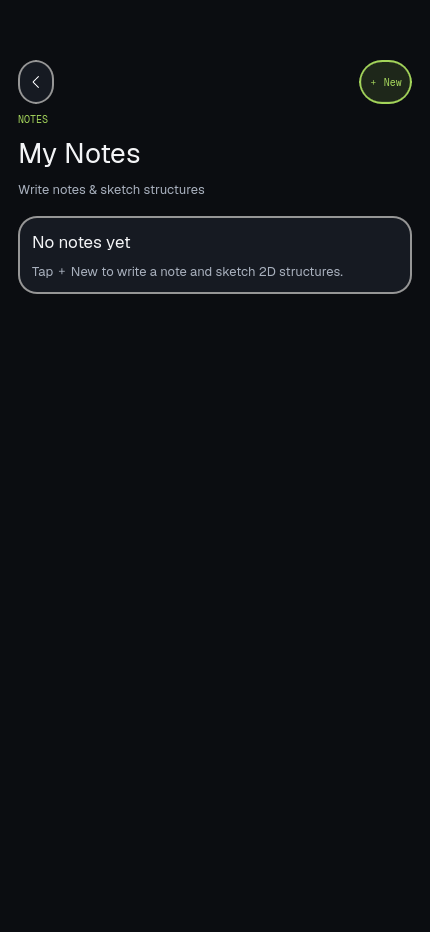
Jot working alongside the reference. Saved on your device, never uploaded.

Offline by construction

Every mechanism, orbital cube, spectrum and reference table ships inside the download. The app makes no network requests at all — not for content, not for analytics, not for crash reports. It works the same on a plane, in a basement lab, or on a phone in airplane mode for a week.

That is also why there is nothing to collect. Chembook has no account, no sign-in, and no server. Your progress, bookmarks and quiz results are files in the app's own storage on your device, and Settings → Reset all data erases them.

We have declared Data Not Collected on the App Store, and the privacy manifest inside the app says the same. Read the Chembook privacy policy.
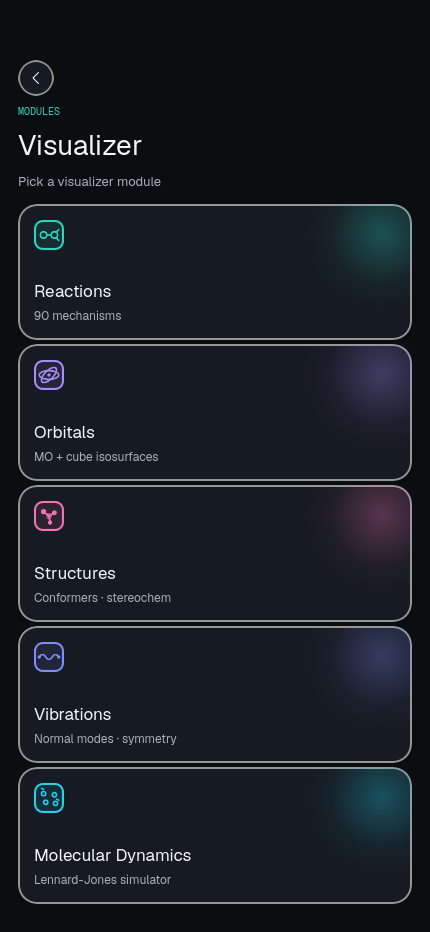
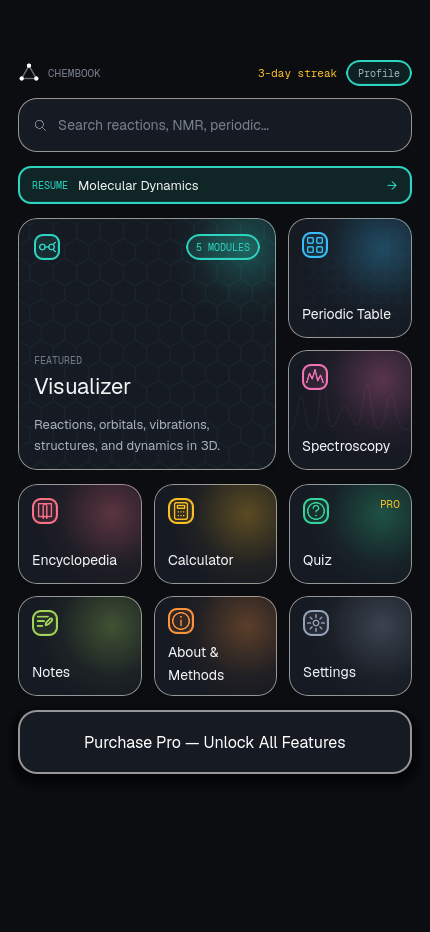
The Chembook home screen with its module tiles and search

Pricing

Most of it is free. One purchase unlocks the rest.

No subscription, no consumables, no ads. A single non-consumable purchase, tied to your App Store account and restorable on any device you own.

Free

$0 no account

  • 20 core reaction mechanisms in 3D, with electron-pushing arrows
  • The full periodic table, all 118 elements with trends and comparison
  • Every spectroscopy tab, all orbitals and structures, the molecular dynamics lab, the encyclopedia and the calculators
  • A set of free rounds in each of the six quiz modes

The free tier is a working reference on its own, not a trial that expires.

Coming to the App Store

Chembook is on its way to iPhone.

Submitted for review. Chembook is a Qemica Lab app — the same people who build the desktop workbench.