Analyze — Inspect Every Result
Analyze is an eleven-tab result viewer — Overview, Geometry, Surfaces, IR/Raman, UV-Vis, NMR, Trajectory, Reactivity, Bonding, Reaction path, and Raw — that surfaces energies, structures, spectra, and dynamics with honest provenance and warnings. Results are searchable and exportable, and any calculation can be reproduced or compared against imported external output.
Overview and Geometry
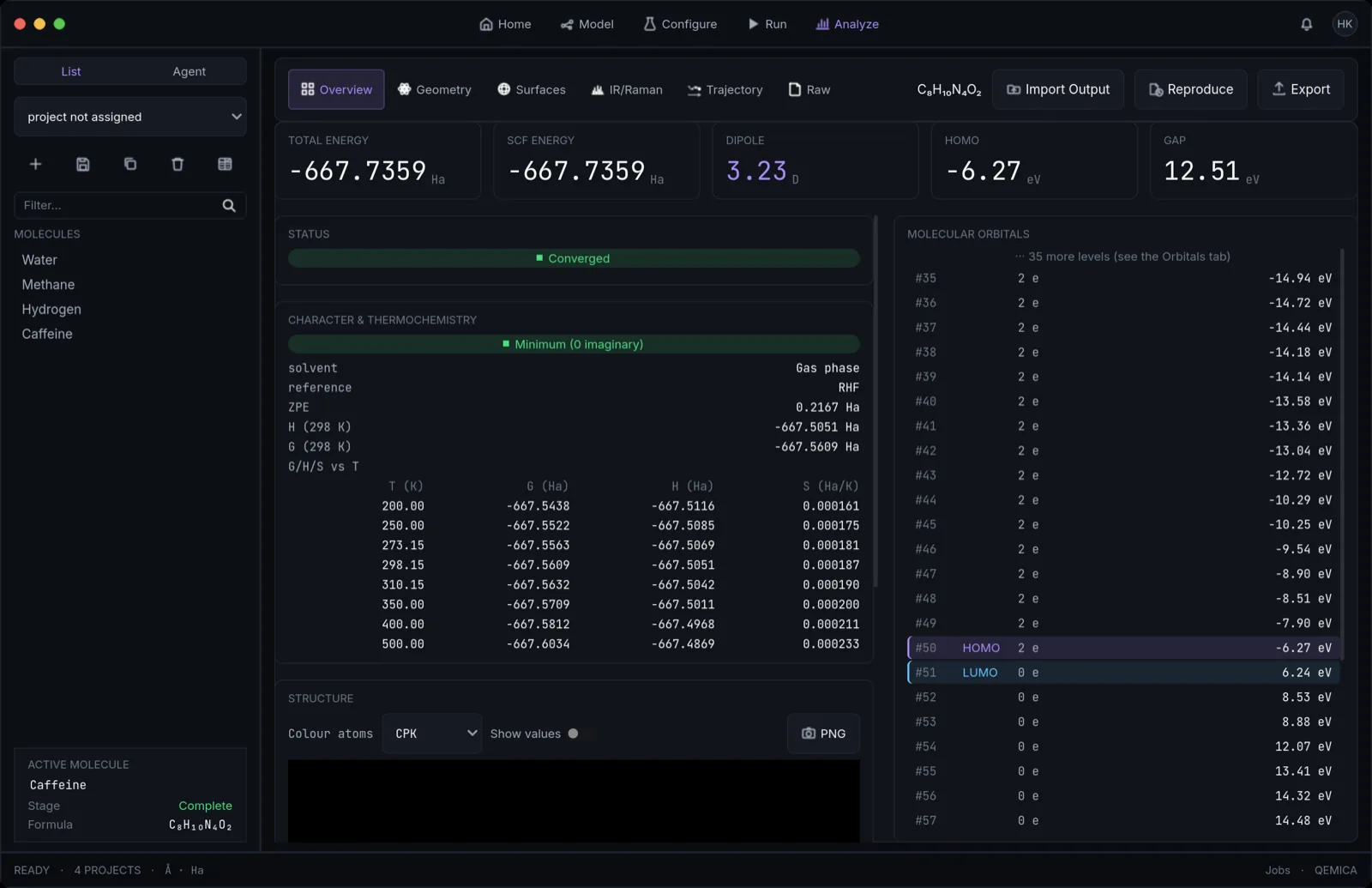
- Overview shows energy cards (total and SCF energy in Hartree, dipole in Debye, HOMO and HOMO–LUMO gap in eV — 'n/a (CASSCF)' for multireference), convergence status, and an MO list with HOMO highlighted violet and LUMO blue.
- A Status channel lists all engine warnings as a counted, bordered panel — degraded capabilities are never silent, and the warnings are the first thing to read on any result. It also shows the stationary-point character, the solvent model, and the SCF reference actually run (UHF/RKS/ROHF).
- Thermochemistry (from frequency jobs): ZPE, enthalpy, and Gibbs free energy; plus ⟨S²⟩ spin diagnostic and polarizability when available.
- Quantum circuit (any quantum-method result — VQE, SQD, QPE, the signal/Krylov family, …): the actual circuit the engine ran — qubit count, ancilla count, mapping, algorithm, circuit depth, and parameters/iterations — the counterpart to the Configure screen's pre-run estimate.
- Atomic properties: recolor the 3D structure by Mulliken/Löwdin/ESP charge, spin density, or Fukui dual descriptor, with optional per-atom value and bond-order labels; population charges also appear as a diverging bar chart with CSV export.
- Geometry tab: a CPK 3D viewer with measure mode (2 atoms for distance, 3 for angle, 4 for dihedral), point group and rotational constants, a Cartesian or Z-matrix table (export .xyz/.mol/.pdb), and Kabsch-RMSD comparison against another stored result.
When Qemica tells you not to trust a number
A calculation that finishes is not the same as a calculation you can use. These checks run automatically and land in the Status channel; each one marks a result that would otherwise look clean.
- Geometry: a structure that ran out of optimization steps is reported as NOT converged rather than taking its final SCF as success, and frequencies are checked against the nuclear gradient before anything is called a minimum. Harmonic frequencies and every thermochemical quantity assume a vanishing gradient, so a structure that is not a stationary point is labelled as such and its ZPE/H/G marked unusable.
- Basis: anions in a basis with no diffuse functions, and excited states lying above the ionization threshold, are flagged — both are silent tens-of-kcal/mol errors.
- Correlation quality: every CCSD run reports a T1 diagnostic, and a CASSCF wavefunction with strong multireference character (low leading configuration weight, active natural occupations far from 2 or 0) is flagged — single-reference methods are not trustworthy in that regime.
- Solvation: the bundled continuum models (C-PCM, IEF-PCM, COSMO) are electrostatic-only — PySCF's continuum has no cavitation, dispersion or repulsion term — so a solvated-minus-gas difference is ΔG_electrostatic, not the full solvation free energy. It is systematically too small for ions and can have the wrong sign for small nonpolar solutes. pKa and redox cycles built on it are for ranking related species, not for predicting a value.
- Quantum phase estimation reports the resolution of its phase register alongside the energy. QPE returns the tallest bin of a quantized estimate, so it is not a variational upper bound and can fall below the true eigenvalue — the stated resolution bounds that.
- Provenance: every result records the numerical settings behind it — SCF convergence tolerance, DFT integration grid level, frozen-core convention, and whether the basis used spherical (5d) or Cartesian (6d) d functions. PySCF defaults to spherical where the Pople names and Gaussian mean Cartesian, worth about 1 kcal/mol on an absolute energy, so it is recorded rather than assumed.
Surfaces (orbitals and densities)
- An interactive isosurface viewer renders the selected MO (red lobes ψ > 0, blue ψ < 0); real cube data is loaded off-thread, with a schematic field shown when cubes are unavailable.
- An isovalue slider adjusts the threshold (default 0.05 for orbitals, 0.02 for density), and a surface selector switches between orbital, total electron density, and spin density.
- An MO ladder lists energy levels (eV) with occupations, HOMO/LUMO highlighting, spin-channel toggles for UHF/UKS, and arrow buttons to step orbitals.
- For CASSCF results, an active-space panel shows CAS(nelec,norb), natural occupations (fractional values flag multireference character), and CI weights, with a Run CASSCF button to send a new job to Run.
Spectroscopy: IR/Raman, UV-Vis, and NMR
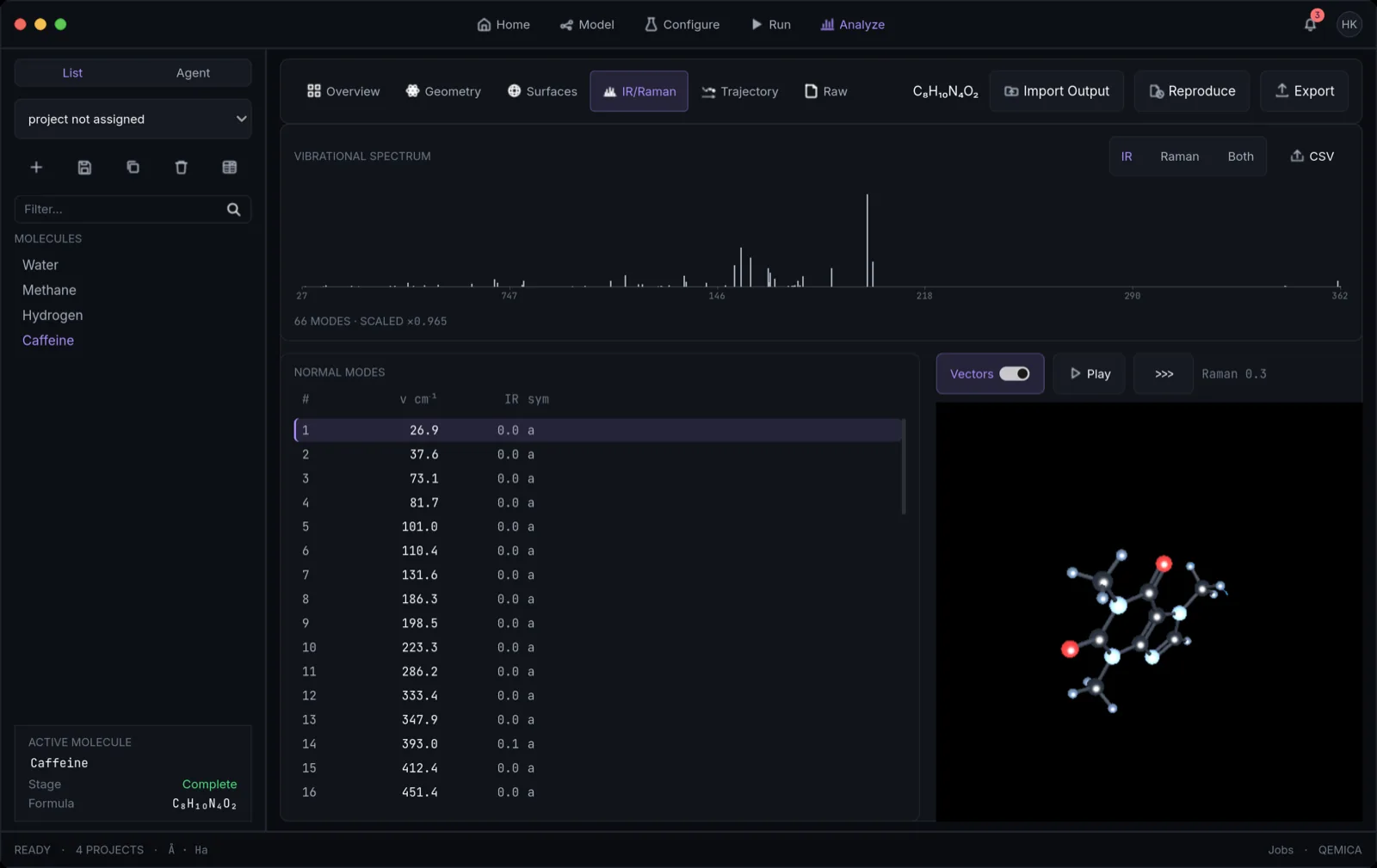
- IR/Raman: an interactive stick spectrum (IR intensity, Raman activity, or both) with a toggleable Lorentzian envelope with adjustable FWHM (2–64 cm⁻¹, default 16; imaginary modes stay visible as raw sticks but never pollute the envelope), a normal-modes table, and a 3D mode-animation viewer with displacement arrows — clicking a stick selects its mode in the table.
- Frequency scaling is per level of theory: harmonic frequencies are overestimates, and the accepted empirical factor depends on the method and basis (HF/6-31G(d) ≈ 0.8929, B3LYP/6-31G(d) ≈ 0.9614, MP2 ≈ 0.9434). Qemica applies the factor published for your level and names it in the caption; where no published factor exists the harmonic values are shown unscaled and labelled as such, rather than given an invented correction. Thermochemistry (ZPE, H, G) always uses the UNSCALED frequencies, and the caption says so — the two numbers on screen come from different sets by design.
- UV-Vis: absorption sticks with a Gaussian-broadened envelope (nm or eV, default 0.30 eV FWHM), an excited-states table, Natural Transition Orbitals (hole→particle pair) when computed, and an ECD spectrum for chiral molecules.
- NMR: ¹H and ¹³C chemical shifts via GIAO on a reversed ppm axis, computed as δ = REF − σ_iso referenced to TMS (¹H 31.6, ¹³C 186.0 ppm), with a shielding table and a Lorentzian envelope whose FWHM default follows the nucleus (0.02 ppm for ¹H, 0.5 ppm for ¹³C).
- Zoom and pan on every spectrum: the mouse wheel zooms about the cursor, dragging pans when zoomed, and double-click (or the reset button) restores the full range — axis labels gain precision as you zoom in.
- Each spectroscopy tab offers CSV export for downstream software or manuscript figures.
Trajectory playback
- Plays any multi-frame result — MD (with time in fs and temperature in K), geometry-optimization paths (step-indexed), relaxed scans, or imported multi-frame .xyz.
- Player controls include Play/Stop, a frame scrubber, speed (0.5×/1×/2×), loop, a state chip naming the trajectory type, and a frame counter.
- Synced charts plot per-frame energy, temperature (MD only), and RMSD from the initial frame; an MD run-parameters card reports the ensemble (NVE, velocity Verlet), steps, timestep, and initial temperature.
- A CSV button exports the trajectory table.
Reactivity, Bonding, Reaction path, and Raw
- Reactivity: conceptual-DFT descriptors — condensed Fukui indices (f⁺, f⁻, and the dual descriptor) per atom, plus global chemical potential μ, hardness η, and electrophilicity ω. Computed as an opt-in property on a single-point job.
- Bonding: NBO-style localized-orbital analysis (intrinsic bond orbitals / Pipek–Mezey) resolving the density into bonds and lone pairs — also an opt-in single-point property.
- Reaction path: NEB results — the per-image energy profile along the minimum-energy path, the barrier from the climbing image, and each image's geometry.
- Raw: the structured result document exactly as the engine returned it, for inspection and debugging.
Actions shared across all tabs
- Export report writes a timestamped, human-readable .txt report summarizing all populated tabs.
- Publication figures: every 3D viewer (structure, orbitals, NTOs, ESP, bonding, MD frame) exports high-resolution PNG at 2–4× with a transparent or white background, and each spectrum exports PNG next to its CSV — including a light publication PNG and true SVG vector output (white page, print-safe colors) for manuscripts; Orbitals also saves the volumetric .cube behind the current surface.
- Experimental overlay: import a measured IR/Raman, UV-Vis, or NMR spectrum from a 2-column CSV to plot it over the computed one (peak-normalized or raw), honoring the current zoom and axis.
- Reproduce reconstructs the exact job parameters and sends them to Configure; it is disabled (with a tooltip) for incomplete or externally imported results.
- Import external output via the left panel's Import button — a .log/.out/.dat/.fchk file is parsed via cclib (off-thread) and becomes a new molecule in the project whose result is stamped with 'imported from [filename]' provenance.
- Energy-unit preference (Hartree/eV/kcal/mol) and length units (Å/bohr) apply across tabs and are read from each result — units are never assumed; temperature is always Kelvin, wavenumber cm⁻¹.
Derived quantities — the Compare screen
Beyond single results, the Compare screen combines several results into a derived quantity, each with a level-of-theory-match guard so mismatched inputs are flagged rather than silently combined.
- Solvation free energy: run gas and solvent single points on one geometry and read ΔG_solv, with the standard-state convention applied automatically — PCM/COSMO results receive the +1.89 kcal/mol (RT·ln 24.46) 1 atm→1 M correction.
- Interaction / binding energy: split a complex into fragments to get E_int = E_AB − (E_A + E_B), labeled with the no-counterpoise (BSSE) caveat and whether monomers are taken at the in-complex geometry (interaction energy) or relaxed (binding energy, includes deformation).
- Method / functional benchmark: sweep several levels of theory on one geometry and compare total energies and ΔE-vs-reference side by side — cross-basis rows are flagged since absolute energies are not comparable across basis sets.
- Conformer ensemble: save a whole ETKDG ensemble, optimize it, and get Boltzmann populations and Boltzmann-averaged properties weighted by QM Gibbs free energy (falling back to SCF energy with a warning when a frequency job is absent).
- Reaction path / energy diagram: a ΔG/ΔH/ΔE profile with barriers across reactant, transition state, and product results.
- pKa and reduction potential: thermodynamic-cycle predictions from the acid/base or oxidized/reduced species in gas and solvent, with the literature proton and standard-hydrogen-electrode reference values applied automatically — each carries a prominent accuracy caveat (continuum estimates are good to ~2–3 pKa units / ~0.2 V) and never reports a falsely precise number.
- Complete-basis-set (CBS) extrapolation: run one method across a systematic basis-set ladder (cc-pVXZ, aug-cc-pVXZ, or def2) as single points on one geometry and read the extrapolated basis-set limit. The SCF energy is extrapolated exponentially — two-point E(X) = E_CBS + A·exp(−α√X) with published per-family exponents, or an exact three-point fit when three consecutive cardinal numbers are present — and the correlation energy as X⁻ᵝ from the two largest basis sets, so the post-HF total (MP2, CCSD, CCSD(T), FCI) is assembled as extrapolated SCF + extrapolated correlation. Honesty guards: DFT ladders are accepted but flagged approximate (DFT has no rigorous CBS convergence law), a basis outside the systematic families (STO-3G, Pople) is skipped with a warning, and legs that mix basis families or methods are refused with the reason shown rather than averaged into a meaningless number.
References
- Conceptual DFT / FukuiParr & Yang, J. Am. Chem. Soc. 106, 4049 (1984); Geerlings, De Proft & Langenaeker, Chem. Rev. 103, 1793 (2003)
- IBO / IAOKnizia, J. Chem. Theory Comput. 9, 4834 (2013)
- Pipek–Mezey localizationPipek & Mezey, J. Chem. Phys. 90, 4916 (1989)
- Population analysisMulliken, J. Chem. Phys. 23, 1833 (1955); Löwdin, J. Chem. Phys. 18, 365 (1950)
- GIAO (NMR)Ditchfield, Mol. Phys. 27, 789 (1974); Wolinski, Hinton & Pulay, J. Am. Chem. Soc. 112, 8251 (1990)
- NTOsMartin, J. Chem. Phys. 118, 4775 (2003)
- NEB (climbing image)Henkelman & Jónsson, J. Chem. Phys. 113, 9978 (2000); Henkelman, Uberuaga & Jónsson, J. Chem. Phys. 113, 9901 (2000)
- Kabsch RMSDKabsch, Acta Crystallogr. A 32, 922 (1976); A 34, 827 (1978)
- Harmonic scale factorsScott & Radom, J. Phys. Chem. 100, 16502 (1996)
- Proton solvation (pKa)Tissandier et al., J. Phys. Chem. A 102, 7787 (1998)
- pKa continuum reviewHo & Coote, Theor. Chem. Acc. 125, 3 (2010)
- Absolute SHE / redoxIsse & Gennaro, J. Phys. Chem. B 114, 7894 (2010); Trasatti, Pure Appl. Chem. 58, 955 (1986)
- Counterpoise / BSSEBoys & Bernardi, Mol. Phys. 19, 553 (1970)
- Quasi-RRHO free energiesGrimme, Chem. Eur. J. 18, 9955 (2012)
- CBS correlation extrapolationHelgaker, Klopper, Koch & Noga, J. Chem. Phys. 106, 9639 (1997); Feller, J. Chem. Phys. 96, 6104 (1992)
- CBS extrapolation exponentsNeese & Valeev, J. Chem. Theory Comput. 7, 33 (2011)